|
|
||||
|
|
To visitors unfamiliar with South
Philadelphia, it may seem unusual that a Pennsylvania State
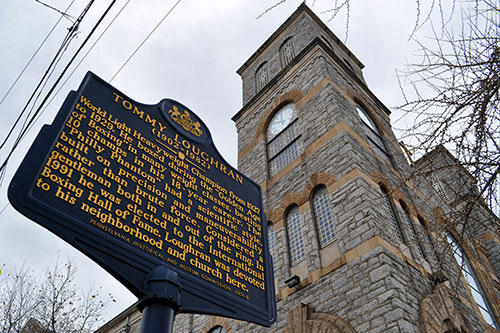
Historical Marker outside Saint Monica Parish honors a prizefighter.
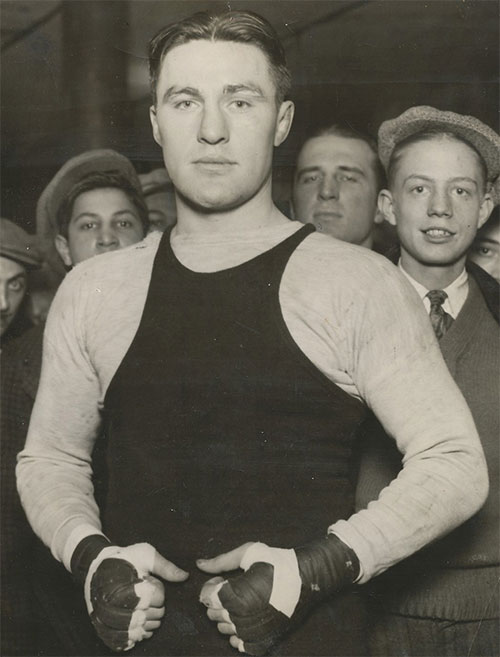
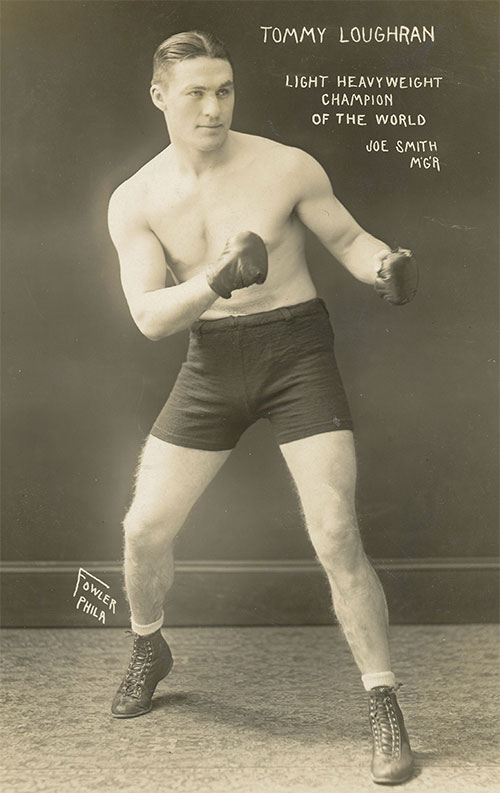
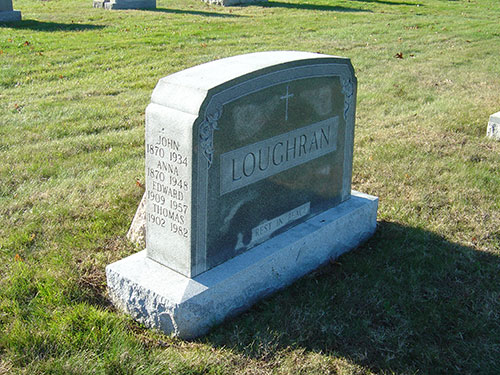
That marker commemorates Tommy Loughran, a lifelong neighborhood
resident and parishioner. Loughran fought professionally from 1919
to 1937, a period widely regarded as boxing’s “Golden Age.” Known as
the “Philly Phantom,” he is remembered as one of the greatest light
heavyweight fighters of all time. The presence of Loughran’s marker in front
of Saint Monica Parish at 2422 South 17th Street reflects the deep
ties between faith, community, and neighborhood identity in South
Philadelphia. The parish itself traces its roots to the late
nineteenth century, when Archbishop Patrick John Ryan of the
Archdiocese of Philadelphia recognized the need to serve a rapidly
growing Roman Catholic population in the area. Irish and Italian
families were settling the surrounding streets in large numbers,
creating a community built around church, school, and shared
tradition. Among those families were the Loughrans, whose son Tommy
was born in 1902.
In 1895, Archbishop Ryan directed Father
Owen P. McManus, assistant pastor of Saint Theresa Church, to
organize a new parish and construct a church and school near Ritner
Street, between 17th and 18th Streets. Rather than build entirely
anew, materials from the closed St. Veronica Church at Second and
Butler Streets were dismantled and transported south. Reassembled at
the new site, the chapel could accommodate approximately 650
worshippers. It was completed on May 24, 1895, and Saint Monica
Parish officially opened for services. A rectory followed two years
later, further anchoring the parish within the neighborhood. From its earliest years, Saint Monica
functioned as more than a place of worship. The Servants of the
Immaculate Heart of Mary assisted with religious education, while
parish societies such as the Sodality and Holy Name Society provided
structure, fellowship, and mutual support. As the neighborhood grew,
so did parish life. The parish supported clubs, youth organizations,
and charitable efforts, including a day nursery for working
families. By the 1920s, the parish numbered more than 1,100
families, reflecting the density and vitality of South Philadelphia
at its peak. The Great Depression tested that community,
but Saint Monica responded by focusing inward, emphasizing charity
and assistance for those struggling to get by. The parish endured,
and the years following the Depression brought renewed growth. In
1944, Father Aloysius F. X. Farrell became pastor and quickly set
about expanding the parish’s educational mission. Saint Monica
Kindergarten opened in 1945, and education remained a priority
throughout the 1950s.
In 1962, the parish purchased the former
Baldwin Elementary School at 16th and Porter Streets and opened
Saint Monica School. Structural deterioration soon rendered the
building unsafe, prompting the construction of a new facility. The
new Saint Monica School opened on September 8, 1965. Under Father
Farrell’s leadership, parish life extended well beyond classrooms
and pews. Choir programs, youth organizations, and recreational
opportunities, including Camp Saint Monica—reinforced the parish’s
role as a center of community life. Tragedy struck on the morning of January 8,
1971. Earlier that day, Monsignor Farrell celebrated his fortieth
year of service to the parish. Hours later, a fire tore through the
church, destroying everything except the exterior walls. The loss
was devastating, but familiar to a neighborhood accustomed to
rebuilding. According to some sources, Loughran, a lifelong
parishioner of Saint Monica Parish, made significant contributions
toward the reconstruction of the church following the devastating
1971 fire. The church was restored and reopened on May 25, 1971,
standing as a testament to the resilience of the parish and its
people. Father Farrell passed away on March 1, 1979.
In recognition of his decades of service and deep connection to
Saint Monica, he was buried on the church grounds. As of 2016, both
the church and school remained active, continuing a legacy that
stretched back more than a century. It was within this world that Tommy Loughran
came of age. He grew up in a blue-collar, Irish-American household
shaped by work, discipline, and parish life. Like many boys of his
generation, he left high school early to help support his family,
working at the Philadelphia Navy Yard and for a neighborhood
blacksmith. Boxing offered opportunity and escape, but it also
demanded patience, intelligence, and restraint, qualities that came
to define his style.
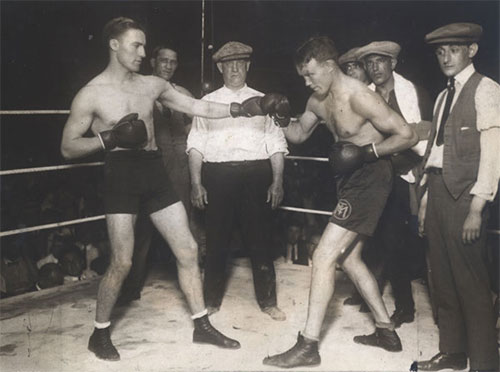
On October 7, 1927, Loughran defeated Mike
McTigue at Madison Square Garden to win the World Light Heavyweight
Championship. He defended the title multiple times before
relisquishing the crown to chase the heavyweight championship.
Loughrahn challenged champion Primo Carnera for the title in 1934,
but lost by decision over 15 rounds. Loughran retired in 1937 with a
remarkable professional record of 90 wins, 25 losses, and 10 draws,
including victories over ten champions. His elusive, tactical
approach earned him the nickname “Philly Phantom” and a lasting
reputation as one of the division’s most intelligent fighters. After leaving the ring, Loughran remained
connected to boxing as a referee and later built a second career as
a Wall Street sugar broker. He died in 1982 at the age of 79 and was
posthumously inducted into the International Boxing Hall of Fame in
1991. The Pennsylvania State Historical Marker honoring him was
dedicated outside Saint Monica Parish in 2006.
Together, the church and the marker serve as
reminders of how neighborhoods remember themselves. Saint Monica
Parish stands not only as a place of worship, but as a witness to
generations of families who shaped South Philadelphia, including a
young parishioner who grew up on its streets and became one of
boxing’s all-time greats. |
|||
|
|
||||
|
|
||||
|
2026 STORIES |
||||
|
|
||||